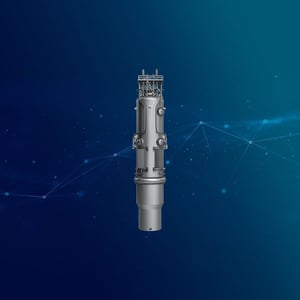

How the Nuclear Supply Chain Powers SMR Deployment
Introduction
When people picture the future of nuclear energy, they usually picture the reactor. A clever new design. A smaller footprint. A safer core. That makes sense. The reactor is what captures the imagination.
But a reactor design, no matter how advanced, cannot deploy itself. A licensed design is a blueprint. Turning that blueprint into an operating power plant, and then into many operating power plants, depends on something far less glamorous and far more important: the supply chain.
The supply chain covers pressure vessels, fuel, instrumentation and controls, specialized welding, and manufacturers who can meet nuclear codes and standards. Get the reactor right, and you have a concept. Get the supply chain right, and you have an industry capable of supporting skilled jobs, manufacturing investment, and economic growth.
This article explains why the supply chain sits at the center of nuclear deployment, how small modular reactors (SMRs) are changing the way nuclear gets built, and where NuScale fits into that picture.
What Makes Nuclear Supply Chains So Challenging?
Nuclear manufacturing is not like building most other industrial equipment. Safety-related components and the activities that affect them are subject to rigorous quality-assurance controls over materials, fabrication, inspection, testing, and documentation. For critical components, records can include detailed material certifications and manufacturing documentation that follow the component through production and installation.
This level of rigor exists for good reason. Nuclear equipment must perform reliably for decades under demanding conditions. But that same rigor makes nuclear hard to scale.
When too much component production is customized for individual projects, and when different countries apply different requirements, the industry can end up rebuilding much of the same capability from scratch, over and over again.
The International Atomic Energy Agency (IAEA) addressed this directly in November 2025. In its work on supply chain readiness, the IAEA noted that scaling nuclear technology remains difficult partly because so much component production is customized and because requirements differ from country to country. It identified better coordination, more consistent standards, supplier development, and reliable supply chains as important enablers of faster nuclear deployment.
The goal, in short, is to move away from treating every nuclear plant as a one-of-a-kind megaproject and toward something closer to a repeatable industrial process.
A simple way to picture the progression: a standard design leads to qualified suppliers, which enables repeatable procurement, which supports manufacturing, which feeds site assembly, which produces an operating plant, which generates repeat orders, which builds the scale and learning needed to do it all more efficiently the next time.
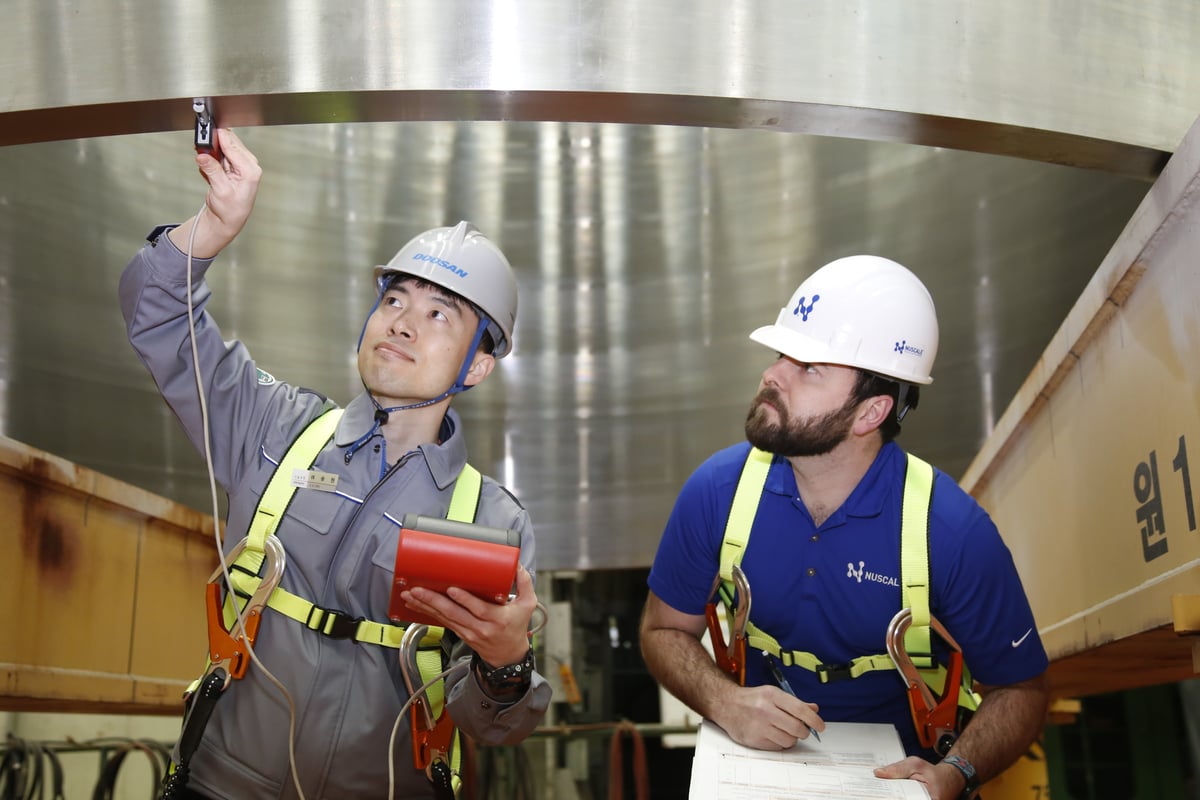
Components for 12 NuScale Power Modules are already in production as of August 2026.
How SMRs Change the Equation
The promise of SMRs is often summarized as "smaller reactors are simpler to build." That is only part of the story. The more important shift comes from three connected ideas:
- Standardization. When the same design is used across multiple projects, teams can reuse engineering work, procurement specifications, and supplier qualifications instead of recreating them each time. Manufacturers can build the same component to the same specification, project after project.
- Modular manufacturing. More of the construction work moves into factory environments rather than happening on site. Components can be produced under stable conditions, sometimes while site preparation is already underway. Specialized work shifts toward facilities that perform the same processes repeatedly, rather than being rebuilt at each new construction location.
- Repetition. Tooling, procedures, trained workers, and supplier relationships carry forward from one module to the next. This is what makes the "factory-built" idea meaningful. It is not only about prefabrication. It is about doing the same work repeatedly, creating opportunities to improve efficiency from one cycle to the next.
A refrigerator offers a familiar example. It is not designed and built from scratch in the home where it will be used. Instead, a factory repeatedly produces the same design using established suppliers, specialized equipment, and trained workers, then delivers it for installation. That repetition helps make manufacturing more consistent and efficient. SMRs can apply those same principles of standardization and repeatability to nuclear manufacturing, construction, and even deployment.
The U.S. Department of Energy (DOE), in its updated Pathways to Commercial Liftoff: Advanced Nuclear, found that repeat projects can carry forward improvements in supply-chain maturity, workforce experience, and project delivery, helping reduce costs over time.
In other words, many of the economic and schedule benefits of SMRs come not from size alone, but from the ability to build the same design repeatedly with a supply chain organized to support it.
NuScale's Supply Chain in Practice
NuScale provides a practical example of what supply-chain readiness looks like for an SMR developer.
- Heavy components and long-lead materials: Doosan Enerbility. Some of the most time-consuming parts of a reactor to produce are the large forgings and long-lead materials that go into the pressure vessel. Because they take so long to make, they need to be ordered well ahead of everything else. NuScale has been advancing this work with Doosan Enerbility, including forging and long-lead material activities that support the manufacture of 12 NuScale Power Modules™.
- Fuel: Framatome. NuScale Power Modules use conventional low-enriched uranium (LEU) fuel based on Framatome's established pressurized-water reactor fuel technology. Unlike many advanced reactor designs that require high-assay low-enriched uranium (HALEU), NuScale can draw on established LEU enrichment and fuel-fabrication infrastructure. This reduces dependence on the development of a new fuel supply chain. In March 2026, NuScale and Framatome expanded their agreement to prepare fuel manufacturing capability in the United States and Europe.
- Protection and control systems: Paragon, a Mirion Technologies company. In June 2026, NuScale awarded Paragon a contract to complete final design work for three instrumentation and control systems, including the safety-related Module Protection System. These digital systems help monitor and protect the reactor. Completing their design and verification is another step toward manufacturing and deployment readiness.
NuScale has a supply chain of more than 60 specialized partners, over 30 executed agreements, and components for 12 NuScale Power Modules already in production.
What makes this more than a list of partners is the level of planning behind it. NuScale's manufacturing planning extends well beyond component specifications to detailed production processes, fabrication methods, and inspection requirements. That kind of detailed, documented planning is what allows manufacturing to be repeated consistently from one module to the next.
Supporting all of this is an approved design. In May 2025, the U.S. Nuclear Regulatory Commission (NRC) issued the Standard Design Approval for NuScale's US460 design, a six-module configuration with each module rated at 77 MWe. An approved design gives suppliers a fixed target to plan and build against. While it does not eliminate site-specific licensing or construction requirements, it provides a common baseline that can be used across projects.
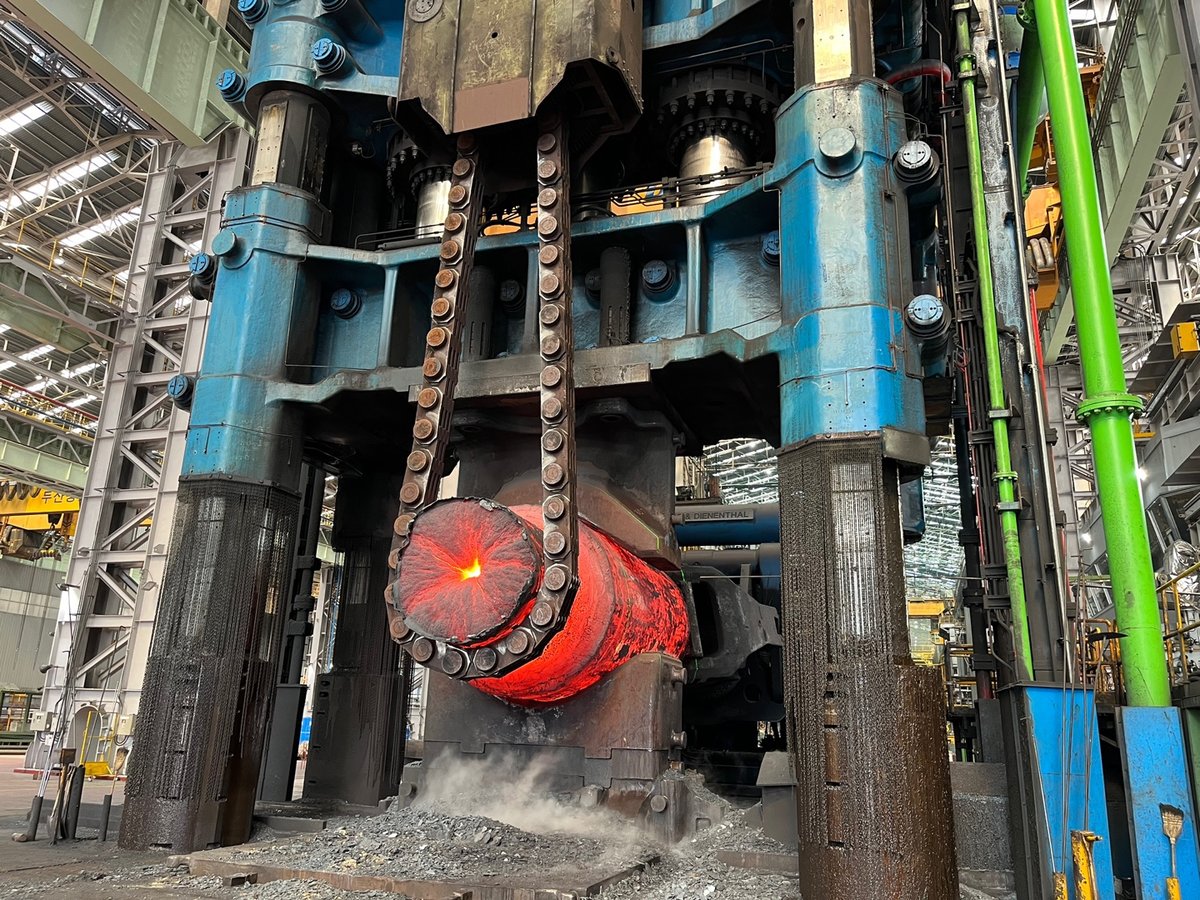
In 2023, Doosan began the forging production process for the first NuScale Power Modules.
Conclusion
For SMRs, supply-chain readiness is part of reactor readiness. Standardized designs enable repeat production, allowing suppliers to build experience, refine processes, and carry lessons from one module to the next. That is how modular nuclear can move toward a more repeatable industrial process.
NuScale is developing those pieces alongside its reactor technology, from long-lead forgings and fuel manufacturing to digital protection systems and production planning. Together with the US460 Standard Design Approval from the NRC and an established light-water reactor fuel base, that work supports the move from design approval to manufacturing and deployment. The reactor may be the most visible part of an SMR project, but building it repeatedly, predictably, and at scale depends on everything behind it.